
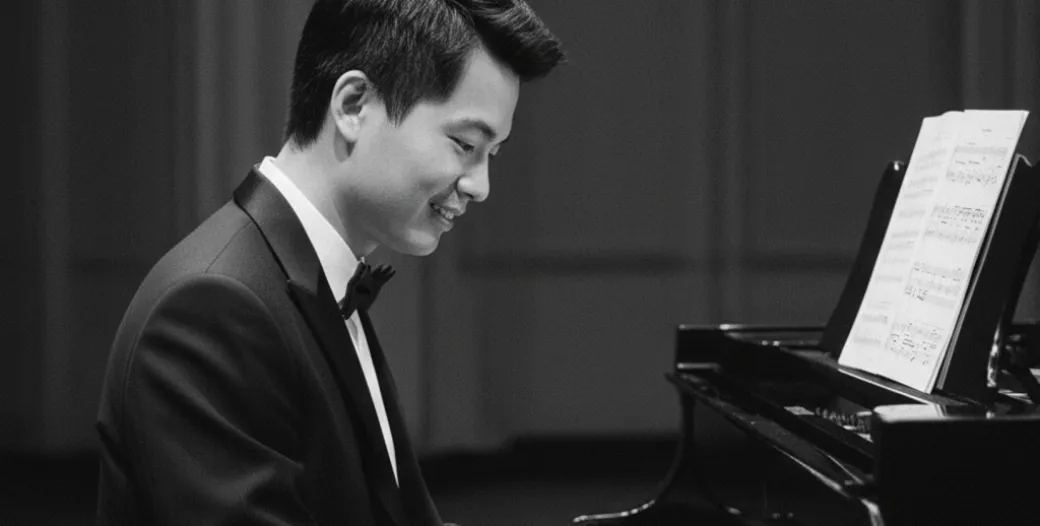
Wilson Gao, Senior Minor Recital, piano
Program
Piano Sonata No. 3, Allegro maestoso, Op. 5 (1853) by Johannes Brahms (1833 – 1897)
Jeux d'eau (1901) by Maurice Ravel (1875 – 1937)
Études-Tableaux Op. 39, No. 5 (1916 – 1917) by Sergei Rachmaninoff (1873 – 1943)
Transcendental Étude No. 12 (1852) by Franz Liszt (1811 – 1886)
Biography
Wilson Gao, 21, is a senior at Washington University in St. Louis majoring in computer science and mechanical engineering, with minors in economics and music. He has studied piano for sixteen years and currently works with Amanda Kirkpatrick, having previously studied with Laura Schindler from 2017 to 2022.
Wilson has earned multiple honors in the Missouri Music Teachers Association State Piano Competition, including first place in Solo Piano in both 4th and 9th grade and second place in 8th and 11th grade. In 2022, he performed Prokofiev’s Toccata at the Fox Theater as a finalist in the St. Louis Teen Talent Competition, where he received the $1,500 Burgess Award for Classical Performance. Most recently, Wilson placed second in the 2025-2026 WashU Concerto and Aria Competition, playing Beethoven’s Fifth Piano Concerto. He has also participated in masterclasses with Javor Bracic, Brian Woods, Victor Rosenbaum, Sir Stephen Hough, and Conrad Tao.
Program Notes
Brahms – Composed when Brahms was just twenty, this sonata would become the last he ever wrote in the genre. The first movement unfolds from two contrasting musical ideas: a bold, march‑like theme with steady, grounded rhythm, and a lyrical, singing second subject cast in a warm major key. As the movement progresses, these ideas intertwine and intensify, ultimately converging in a triumphant, sweeping coda.
Ravel – Jeux d’eau (“Fountains,” “Playing Water,” or literally “Water Games”) was Ravel’s first major work, written six years after his expulsion from the Paris Conservatoire for a lack of prizes. Often cited as an early landmark of musical Impressionism—a label Ravel himself disliked—the piece inspired later works by Debussy and others. Brilliant and technically intricate, it evokes the play of light on moving water through shimmering textures, cascading figures, and a sense of effortless fluidity.
Rachmaninoff – Rachmaninoff’s two sets of Études‑Tableaux (“study‑paintings”) explore vivid emotional and pictorial ideas. The Op. 39 set, composed as he fled the turmoil of the October Revolution, is darker and more intense than its predecessor. The fifth etude is fiery and impassioned, shifting between forceful declamation and moments of introspective lyricism. Its energy gradually dissipates, ending in a quiet, fading glow, like a flame burning its last embers.
Liszt – The final work in Liszt’s celebrated Transcendental Études, themselves the culmination of revisions spanning decades, Chasse-neige (“Snow‑whirls”) serves as a poetic end to a set of incredibly demanding works. Built from two simple melodic ideas yet accompanied by constant tremolos, jumps, and chromatic scales, the piece evokes the winter wind: beginning as a gentle breeze, gathering into a powerful, thunderous climax, only to recede into stillness once more.